
Updated 2025 · History & Culture · 9 min read
Right now, as you read this, over 250 million people around the world are reading and writing in an alphabet that traces directly back to two brothers from Macedonia.
Russian. Bulgarian. Serbian. Ukrainian. Mongolian. Dozens of languages across Eastern Europe and Central Asia — all written in scripts that would not exist without the work of two Macedonian scholars born in the 9th century in the city of Thessaloniki, in a region that was deeply and culturally Macedonian.
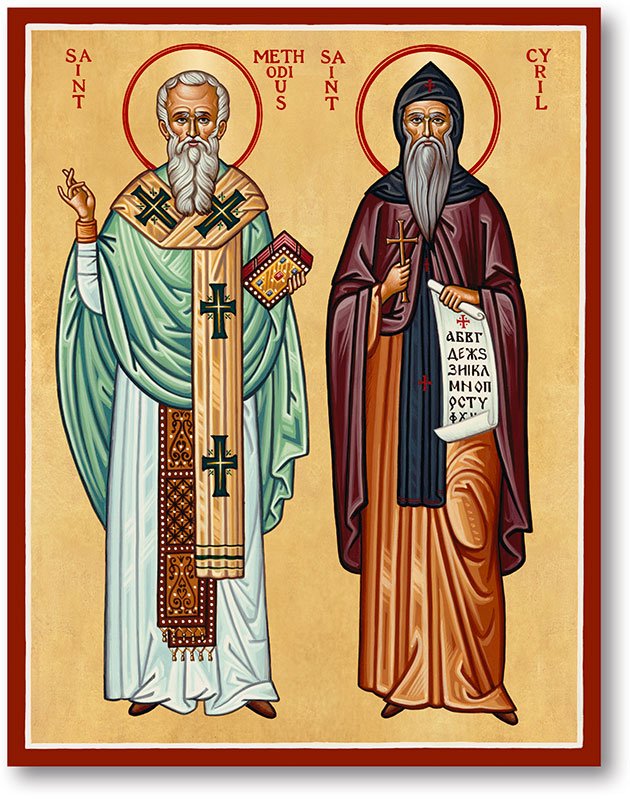
Their names were Cyril and Methodius. What they created changed the course of human history. And almost nobody outside the Slavic world knows where it came from.
In This Guide
- Who Were Cyril and Methodius?
- Why an Alphabet Was Needed
- The Mission to the Slavic Peoples
- What They Created — The Glagolitic and Cyrillic Scripts
- Their Connection to Ohrid and Macedonia
- Saint Naum — The Disciple Who Carried the Work Forward
- Their Legacy — 250 Million People and Counting
- Where to Experience Their Legacy in Macedonia
- FAQ
1. Who Were Cyril and Methodius?
Cyril and Methodius were brothers, born in Thessaloniki in the early 9th century AD into a family with deep roots in the Macedonian cultural world of the time. Thessaloniki was a major city at the crossroads of the Byzantine Empire, and the region around it was home to a large Slavic-speaking population alongside the established Byzantine culture.
Cyril — born Constantine, taking the name Cyril only shortly before his death — was the younger brother and the intellectual powerhouse of the pair. He was educated in Constantinople at the imperial court, mastered multiple languages, and became a philosopher and theologian of considerable reputation before he was thirty. Methodius, the elder brother, had a career in Byzantine administration before eventually following his brother into a life of scholarship and missionary work.
Together they would undertake one of the most consequential intellectual and spiritual missions in the history of the medieval world — a mission that began in Macedonia and whose results are still felt every single day by hundreds of millions of people.
2. Why an Alphabet Was Needed
In the 9th century, the Slavic peoples of Central and Eastern Europe had no written language. They spoke — and their languages were rich, complex, and alive — but nothing was written down. No scripture. No law. No literature. No history recorded in their own tongue.
This mattered enormously in a world where Christianity was spreading and the church required people to read scripture, follow liturgy, and receive religious education. To bring Christianity meaningfully to Slavic peoples, you needed to give them the words in their own language. And to give them words in their own language, you first needed to give them a way to write it.
This was the problem that Cyril and Methodius were asked to solve. And they solved it in a way that nobody before them had attempted — not by adapting an existing alphabet imperfectly to new sounds, but by creating something entirely new, built from the ground up to capture the full phonetic range of the Slavic language.
What they created was not a rough approximation. It was a precise, thoughtful, linguistically sophisticated writing system designed specifically for the sounds of the Slavic tongue. It was, by any measure, a remarkable intellectual achievement.
3. The Mission to the Slavic Peoples
In 862 AD, the Moravian prince Rastislav sent a request to the Byzantine Emperor Michael III. He wanted missionaries — but not just any missionaries. He wanted people who could teach Christianity in the Slavic language, not in Latin or Greek. He wanted his people to understand what they were being taught.
The Emperor turned to Cyril and Methodius. They were the right choice for reasons beyond their scholarship — they had grown up in Thessaloniki surrounded by Slavic speakers. They knew the language. They understood the people.
Before departing on the mission, Cyril created the Glagolitic alphabet — the first writing system designed specifically for the Slavic language. It was an extraordinary act of intellectual creation: a man sitting down and inventing, from first principles, a complete writing system for a language that had never been written before.
They traveled to Moravia — in what is now the Czech Republic — and began their work. They translated scripture. They trained clergy. They created a written literary tradition where none had existed. For three years they worked in Moravia, building the foundations of Slavic literacy.
The mission faced fierce opposition from Frankish clergy who wanted Latin to remain the sole language of the church. Cyril and Methodius went to Rome to defend their work. The Pope supported them. The right of Slavic peoples to worship and read in their own language was affirmed.
Cyril died in Rome in 869 AD, aged 42, shortly after that vindication. He did not live to see the full scale of what he had set in motion.
4. What They Created — The Glagolitic and Cyrillic Scripts
Cyril created the Glagolitic alphabet — a highly original script with no direct precedent in any existing writing system. It was designed with remarkable care to represent the specific sounds of the Slavic language, including sounds that no existing alphabet had letters for.
After Cyril’s death, his disciples — working primarily from Ohrid in Macedonia — developed a second script based on their teacher’s work. This script, created in Macedonia and named Cyrillic in honour of Cyril, was simpler and more closely related to the Byzantine Greek letters that the disciples already knew. It was the Cyrillic script — not the original Glagolitic — that spread across the Slavic world and became the dominant writing system of Eastern Europe and Central Asia.
The Cyrillic alphabet is today the official script of Russia, Bulgaria, Serbia, Belarus, Ukraine, North Macedonia, Mongolia, Kazakhstan, Kyrgyzstan, Tajikistan, and many other nations. It is used to write dozens of languages by over 250 million people every day.
It was created in Macedonia. That is not a footnote — it is the fact.
5. Their Connection to Ohrid and Macedonia
After Cyril’s death in Rome, Methodius continued the work until his own death in 885 AD. When he died, his disciples — who had been trained in the Macedonian literary and scholarly tradition — were expelled from Moravia by the Frankish clergy who had always opposed their work.
They came to Macedonia.
Specifically, they came to Ohrid — the city on the ancient lake in southwestern Macedonia that would become the most important centre of Slavic literacy and culture in the medieval world. The Bulgarian Tsar Boris I welcomed them and gave them the support to continue their work. In Ohrid, the disciples of Cyril and Methodius established a literary school that became the beating heart of Slavic written culture.
It was here, in Ohrid, that the Cyrillic script was developed and refined. It was here that the first Slavic literature was written, copied, and distributed. It was here that the tradition Cyril and Methodius began in Moravia took permanent root and grew into something that would spread across half the world.
Ohrid in the late 9th and early 10th century was, in terms of its cultural and literary significance, one of the most important cities in the medieval world. The fact that almost no one outside Macedonia knows this is one of history’s quiet injustices.
6. Saint Naum — The Disciple Who Carried the Work Forward
Among the disciples who came to Ohrid after the expulsion from Moravia, one stands above the rest in terms of his contribution to what followed.
Saint Naum was one of the closest and most talented disciples of Cyril and Methodius. He came to Ohrid and worked alongside Saint Clement — the leader of the disciples — in establishing the Ohrid Literary School. He was a scholar, a teacher, and a man of deep spiritual conviction whose work in Macedonia helped turn the vision of Cyril and Methodius into a lasting institution.
At the southern end of Lake Ohrid — in one of the most beautiful locations in all of Macedonia — Saint Naum founded the monastery that bears his name in 905 AD. The Monastery of Saint Naum still stands today, on the same ground, above the same crystal-clear springs that feed the lake. Peacocks roam the monastery grounds. The church contains the tomb of the saint himself.
When you visit the Monastery of Saint Naum — arriving by boat across the lake, the monastery rising from the cliff above the water — you are visiting a place that is directly and physically connected to the moment when the written Slavic world was born. That is not a metaphor. That is history you can stand inside.
7. Their Legacy — 250 Million People and Counting
The scale of what Cyril and Methodius set in motion is almost impossible to fully grasp.
Every Russian novel ever written. Every Ukrainian poem. Every Serbian newspaper. Every Bulgarian legal document. Every Mongolian text. Every Kazakh government notice. The entire written tradition of dozens of nations and hundreds of millions of people — all of it flows from the work that began with two brothers from Macedonia and continued in the schools of Ohrid.
May 24th is celebrated as the Day of Slavic Culture and Literacy across Macedonia and the wider Slavic world — a public holiday honouring the legacy of Cyril and Methodius and the gift of written language they gave to half a continent.
In Skopje, statues of the two brothers stand as permanent reminders of what Macedonia contributed to the world. In Ohrid, the connection is even more direct — you can visit the places where their disciples lived, worked, and built the foundations of Slavic literacy with their own hands.
The next time you see a word written in Cyrillic — on a Russian street sign, in a Serbian newspaper, in a Mongolian text — remember where it came from. It came from Macedonia.
8. Where to Experience Their Legacy in Macedonia
Monastery of Saint Naum, Ohrid — The most direct physical connection to the story. Founded by the disciple of Cyril and Methodius in 905 AD, still standing on the same ground above the same lake springs. Arrive by boat from Ohrid for the full experience.
👉 Book a boat trip to Saint Naum →
Saint Sophia Church, Ohrid — The great Byzantine church of Ohrid, built in the era when the city was the centre of Slavic literary culture and the seat of the Ohrid Archbishopric — one of the most important religious institutions in the medieval Slavic world.
The Archaeological Museum of Macedonia, Skopje — Houses collections that illuminate the Byzantine and medieval Macedonian world that Cyril and Methodius were part of.
Macedonia Square, Skopje — The statues of Saints Cyril and Methodius in the square are among the most visited monuments in the city — a daily reminder to every person who passes that this country gave the world something permanent and extraordinary.
👉 Find hotels in Ohrid → 👉 Find hotels in Skopje →
9. FAQ
Did Cyril and Methodius actually create the Cyrillic alphabet? Cyril created the Glagolitic alphabet — the first writing system designed for the Slavic language. The Cyrillic alphabet was developed by his disciples in Ohrid, Macedonia, after his death, based on his work and named in his honour. So while Cyril did not personally write the Cyrillic letters, the script exists because of him and was created in Macedonia by the people he trained.
How many people use Cyrillic today? Over 250 million people use Cyrillic-based scripts as their primary writing system, across dozens of languages including Russian, Ukrainian, Bulgarian, Serbian, Macedonian, Mongolian, and many others.
Why is May 24th significant? May 24th is celebrated as the Day of Slavic Culture and Literacy — a public holiday in Macedonia and several other countries that honours the legacy of Saints Cyril and Methodius and the creation of the Slavic written tradition.
Where is the Monastery of Saint Naum? At the southern end of Lake Ohrid in Macedonia, approximately 30 kilometres from the town of Ohrid. It is best reached by boat from Ohrid — a trip that takes around an hour each way along the lake and is one of the finest experiences Macedonia offers.
Why is this story not better known internationally? That is one of history’s quiet mysteries. The contribution of Cyril and Methodius to world culture is genuinely enormous — comparable in scale and significance to the invention of moveable type or the creation of the Latin alphabet. That it remains largely unknown outside the Slavic world is simply a matter of which stories get told and which do not. MKGuide is here to tell this one.
Disclosure: MKGuide uses affiliate links to help keep this site free. If you book through our links, we may earn a small commission at no extra cost to you. All opinions are our own, based on real local knowledge of Macedonia.
Leave a Reply